
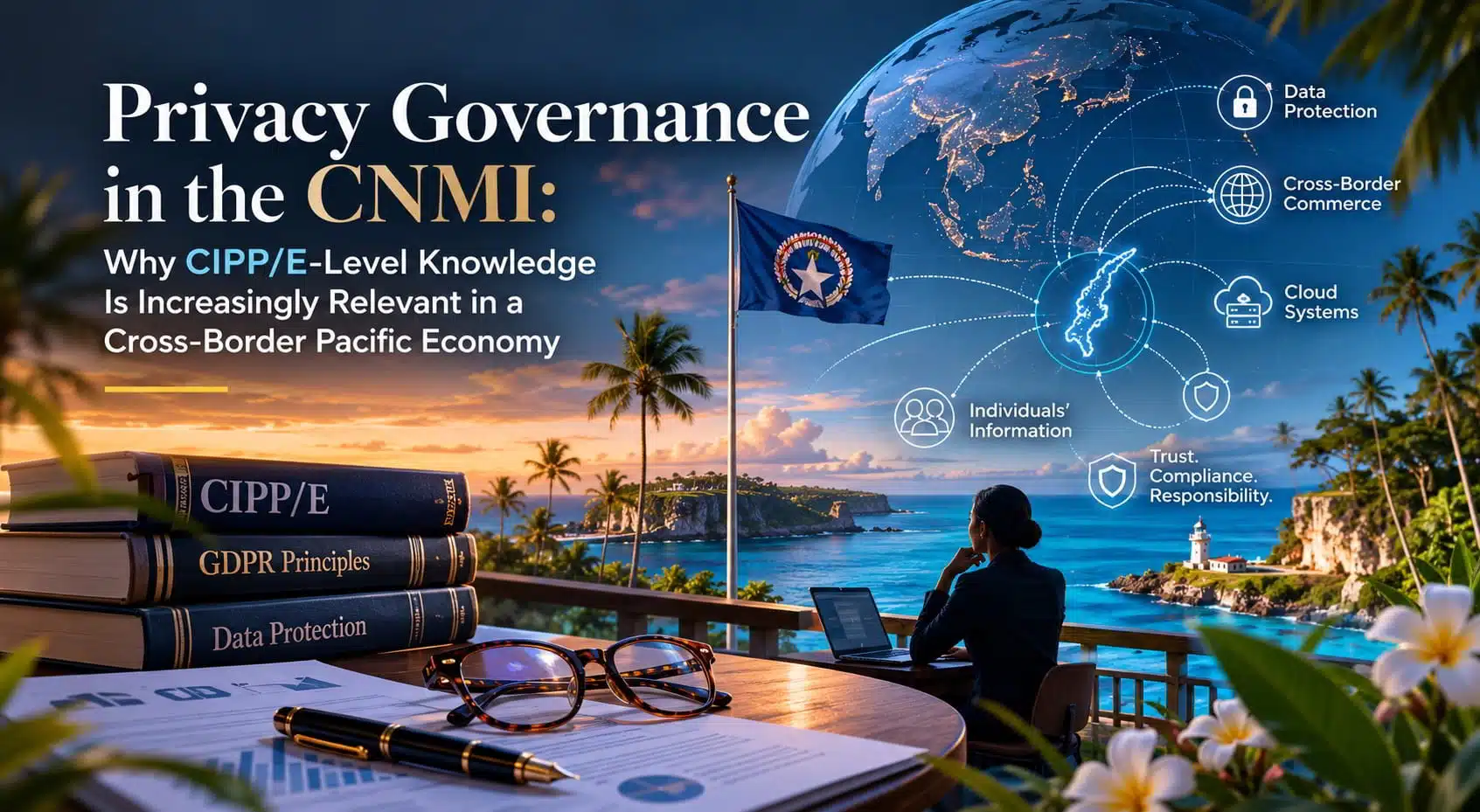
Recent discussions within the Commonwealth business community regarding the possibility of future privacy legislation in the Commonwealth of the Northern Mariana Islands (“CNMI”) reflect a broader reality facing modern Pacific jurisdictions: privacy governance is no longer solely an issue for major technology companies or European regulators. Increasingly, data governance, cybersecurity, and information-management concerns intersect directly with ordinary legal practice, commercial operations, public procurement, tourism, employment administration, and cross-border commerce.
As organizations throughout the region continue adopting cloud-based systems, digital payment infrastructure, remote operational capabilities, and platform-based business models, the legal profession itself is increasingly required to understand how privacy and cybersecurity issues affect litigation risk, operational governance, regulatory compliance, and commercial relationships. In that environment, certifications such as the Certified Information Privacy Professional/Europe (“CIPP/E”) are becoming increasingly relevant not merely for dedicated privacy specialists, but for attorneys practicing in jurisdictions such as the CNMI.
At the same time, if the CNMI eventually considers broader privacy legislation or cybersecurity-related regulatory frameworks, familiarity with internationally recognized privacy principles may become particularly valuable for attorneys, policymakers, and businesses seeking to navigate evolving commercial expectations while balancing the realities of a smaller island economy.
The CNMI’s Increasingly Digital and Cross-Border Economy
The CNMI economy depends heavily on industries that routinely process significant amounts of sensitive information. Tourism operators, hotels, healthcare providers, employers, insurers, logistics companies, financial-service providers, and government agencies all maintain or transmit personally identifiable information (“PII”) through increasingly interconnected digital systems.
Modern hospitality operations may involve international reservation platforms, payment processors, cloud-based customer-management systems, and third-party vendors operating across multiple jurisdictions. Employers handling foreign labor matters routinely process passport information, immigration records, payroll data, tax documentation, and employee medical information. Government procurement systems increasingly rely on electronic submissions, cloud storage, and remote communications platforms.
As a result, many organizations operating within the CNMI already participate in broader international data ecosystems, even where no comprehensive local privacy statute currently exists.
This trend is likely to accelerate as Pacific jurisdictions continue modernizing infrastructure, expanding remote operational capabilities, and pursuing digital economic initiatives.
Privacy Issues Already Affect Ordinary Legal Practice
Importantly, privacy governance is not confined to abstract regulatory policy debates. Attorneys practicing in the CNMI already encounter privacy-related issues through ordinary litigation, employment matters, procurement disputes, and commercial transactions.
Discovery practice increasingly requires counsel to handle electronically stored information (“ESI”), financial records, employee information, medical documentation, confidential business records, and sensitive third-party data. Attorneys routinely navigate redaction obligations, confidentiality protocols, protective orders, and secure handling of electronically transmitted information.
Similarly, procurement and commercial matters increasingly involve cybersecurity and operational-risk considerations. Counsel reviewing vendor agreements or service contracts may need to evaluate:
- confidentiality obligations;
- cybersecurity representations;
- cloud-storage practices;
- third-party data access;
- incident-response responsibilities; and
- contractual allocation of liability arising from unauthorized disclosures or cyber incidents.
As legal practice becomes increasingly digital, attorneys are expected not only to understand substantive law, but also the operational realities underlying how information is collected, stored, transmitted, and protected.
Why International Privacy Frameworks Matter in the CNMI
Even where the GDPR does not directly apply, its influence increasingly extends far beyond Europe. Many multinational companies, technology providers, financial-service platforms, and international vendors now implement GDPR-inspired privacy frameworks globally in order to harmonize operations across jurisdictions.
Concepts such as:
- data minimization;
- lawful processing;
- retention limitations;
- transparency obligations;
- vendor diligence; and
- incident-response planning
have increasingly become part of ordinary commercial compliance expectations.
This is particularly relevant in the Asia-Pacific region, where businesses frequently operate across multiple regulatory systems simultaneously. Companies involved in hospitality, fintech, e-commerce, logistics, and remote services may increasingly expect counterparties and vendors to demonstrate at least baseline familiarity with modern privacy-governance concepts.
For the CNMI, this raises important policy considerations. If the Commonwealth eventually pursues privacy legislation or cybersecurity-related reforms, policymakers may benefit from examining internationally recognized frameworks while tailoring any future regulatory approach to the realities of a smaller island jurisdiction heavily dependent on tourism, investment, and cross-border business activity.
Why CIPP/E Knowledge Provides Practical Value
Against this backdrop, CIPP/E-level knowledge provides practical value not only for privacy specialists, but for attorneys engaged in broader commercial and regulatory practice.
Understanding privacy governance increasingly means understanding:
- how operational systems create legal exposure;
- how cybersecurity incidents affect litigation and compliance risk;
- how vendors allocate technology-related liability contractually;
- how cross-border data transfers intersect with commercial operations; and
- how businesses structure internal governance surrounding sensitive information.
For attorneys practicing in the CNMI, this knowledge may become increasingly relevant in areas including:
- litigation and discovery management;
- employment compliance;
- procurement review;
- cybersecurity-related risk allocation;
- commercial contract drafting;
- tourism and hospitality operations;
- fintech and payment systems; and
- government modernization initiatives.
Importantly, certifications such as the CIPP/E should not be viewed solely as “European privacy” credentials. Rather, they increasingly represent broader operational and commercial literacy regarding how modern organizations manage information risk in a digitally interconnected environment.
A Potential Opportunity for the CNMI Legal Community
As discussions regarding privacy governance and cybersecurity continue developing within the Commonwealth business and policy community, the CNMI legal profession may be uniquely positioned to contribute practical insight regarding how evolving privacy expectations intersect with local operational realities.
Unlike larger jurisdictions with highly specialized regulatory environments, attorneys in smaller jurisdictions often operate across litigation, commercial, employment, procurement, and advisory practice simultaneously. That broader exposure may allow practitioners to evaluate privacy governance not merely as a regulatory abstraction, but as part of everyday operational risk management affecting businesses, agencies, and institutions throughout the Commonwealth.
In that respect, increasing familiarity with frameworks such as the GDPR and certifications such as the CIPP/E may ultimately benefit not only individual practitioners, but also the broader development of commercially practical and operationally realistic approaches to privacy governance within the CNMI.
Conclusion
Privacy governance is no longer a niche issue confined to large technology companies or European regulators. Increasingly, it forms part of the operational and legal realities underlying modern litigation, employment administration, procurement systems, commercial transactions, cybersecurity preparedness, and cross-border commerce.
As the CNMI continues integrating digital infrastructure and internationally connected business systems into daily operations, attorneys practicing within the Commonwealth will likely encounter growing expectations relating to information governance and cybersecurity awareness.
In that environment, CIPP/E-level privacy knowledge provides practical value extending well beyond specialized privacy practice. It increasingly reflects a broader understanding of how technology, operational risk, commercial governance, and legal exposure intersect within modern legal practice and public policy.

About the Author
Brian P. Li advises clients on cross-border business operations, regulatory compliance, financial technology, technology-driven commercial activity, and operational risk matters in the Commonwealth of the Northern Mariana Islands (“CNMI”) and across the Asia-Pacific region.