
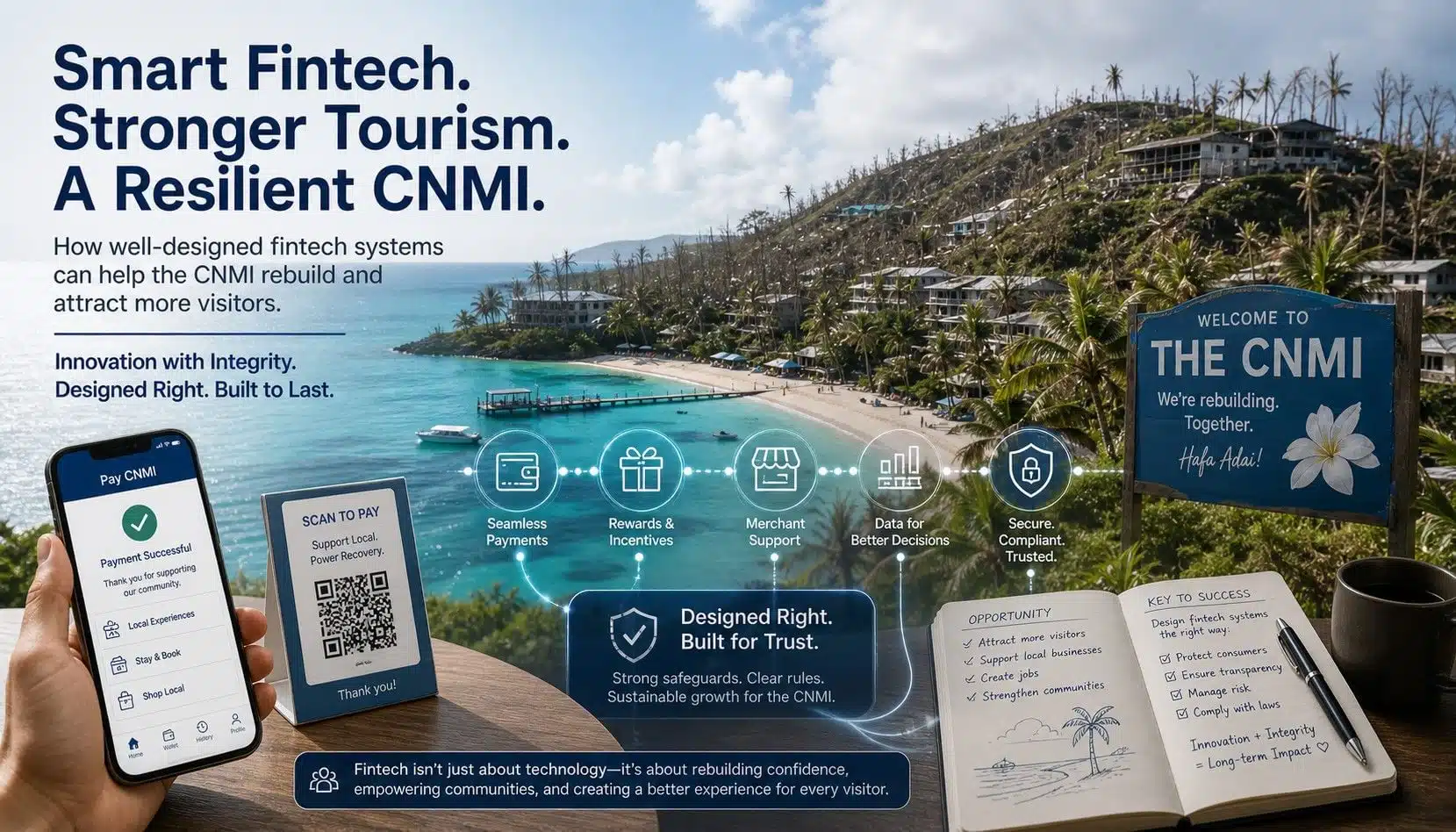
Financial technology (“fintech”) refers to the use of digital systems to deliver financial services, including payments, transfers, and stored value. Increasingly, fintech incorporates digital assets such as cryptocurrencies and stablecoins to enable faster and more flexible transactions across jurisdictions.
In the aftermath of recent typhoon-related disruptions in the CNMI, reliable and accessible payment infrastructure has become even more critical to supporting economic recovery, particularly in tourism and local commerce. Expanding digital infrastructure in the CNMI—including satellite-based broadband services such as Starlink—is improving the connectivity needed to support these systems and enable more resilient financial operations. Against this backdrop, recent fintech initiatives highlight both the opportunities and the legal and operational risks of deploying payment and token-based systems in a U.S.-linked regulatory environment.
Recent fintech developments in the Commonwealth of the Northern Mariana Islands (“CNMI”) highlight practical challenges for digital platforms in travel, tourism, and e-commerce when designing payment and token-based systems in emerging markets. Often described as cryptocurrency initiatives, these developments fundamentally concern how platforms structure payments, manage customer funds, and coordinate cross-border transactions in compliance with law.
Payment Systems Disguised as “Tokens”
A proposed CNMI-based cryptocurrency project illustrates how token systems increasingly function as payment infrastructure. The model integrates merchant payments, user incentives, and transaction-linked revenue allocation into a single ecosystem (Marianas Variety, May 3, 2026). From a product perspective, this resembles a hybrid of:
- a digital wallet
- a loyalty or rewards program
- a closed-loop payment network
Legal and operational risks are driven not by the label (“token”) but by how funds move through the system. Questions about custody, control of funds, and user balances become central to compliance and product design.
Regulatory Risk as a Product Constraint
A separate CNMI private initiative involving a local government-enabled stablecoin shows a different issue: regulatory durability. Legal challenges to the underlying authority have delayed the project, creating uncertainty about whether it can be implemented (Marianas Variety, Jan. 28, 2026).
For platform operators, this shows that regulatory risk is not abstract but directly affects:
- product launch timelines
- partner integrations
- user trust in payment systems
A payment feature that cannot operate consistently is a product failure.
Stablecoins and Payment Regulation
The GENIUS Act (2025) reflects a broader shift toward treating stablecoins as regulated payment instruments. The framework imposes requirements on reserves, redemption, and compliance, and limits the extent to which state-level regimes can diverge from federal standards (KPMG Regulatory Alert, May 2026).
This reinforces a key point for platform design:
Payment systems are increasingly regulated based on function, not form.
Wallet balances, credits, or tokenized value may fall within financial regulatory frameworks depending on their structure and use.
Implications for Digital Platforms
These issues are directly relevant to global travel and e-commerce platforms operating across jurisdictions. Such platforms routinely:
• hold customer funds prior to service delivery
• coordinate settlements with merchants
• manage refunds, credits, or vouchers
This is especially relevant for travel and booking platforms that issue refunds, credits, or rebooking vouchers, where the treatment of those balances may affect customer expectations and regulatory obligations.
Structurally, these functions mirror many of the same risks seen in token-based systems, including:
• custody and control of funds
• timing of liability transfer
• cross-border compliance exposure
As digital platforms expand into emerging or tourism-driven markets, deploying efficient and compliant payment systems can directly impact growth, user adoption, and regulatory certainty.
Key Takeaways
• Payment flow determines risk. Legal exposure depends on how funds move, not on product labels.
• Regulatory durability matters. Local authorization may be insufficient if the framework is challenged.
• Stored value is regulated. Credits, wallets, and tokens may all trigger financial regulation depending on structure.
• Product and compliance are linked. Payment features must be designed with regulatory requirements in mind.
Conclusion
CNMI fintech developments demonstrate a broader shift: digital payment systems—whether framed as tokens, wallets, or platform credits—are increasingly recognized as part of the regulated financial system, particularly for global platforms that manage multi-jurisdictional payment flows.
For platform companies, including travel businesses considering investment in the CNMI, the challenge is not just about enabling new payment methods but also about structuring systems that remain operationally reliable and legally sustainable across jurisdictions.

About the Author
Brian P. Li advises clients on cross-border business operations, regulatory compliance, financial technology, technology-driven commercial activity, and operational risk matters in the Commonwealth of the Northern Mariana Islands (“CNMI”) and across the Asia-Pacific region.